
Blog
More stone is coming into Florida by ship and rail. The last mile is still a truck.
FDOT intends to award $20 million in FY28 funding for six Florida aggregate terminals. Ship and rail get the stone in. NewMile runs the truck to the job.

On November 6, 2026, the Florida Department of Transportation posted a Notice of Intended Grant Awards for fiscal year 2028 funding under its Construction Aggregate Program. FDOT intends to award $20 million across six projects that add capacity to move and store construction aggregate at Florida seaports and rail terminals, including $3 million for the SeaPort Manatee Aggregate Terminal Expansion and $3.5 million for the Range Line Aggregate Rail Terminal. The same day, it posted a separate notice intending to award part of fiscal year 2027 funding, including $2 million more for Range Line.
Ship and rail will bring more stone into Florida. The last mile to the job is still a truck. NewMile already runs that haul the way it runs a plant haul: live dispatch, timings at pickup, a digital ticket on every load, invoices at the PO rate, and AI dispatch planning that chains orders so the next pickup is near the last drop.
What FDOT posted
The FY28 notice, under RFA DOT-RFA-27-9009-PB, says 17 applications were received and that the Department intends to award fiscal year 2028 funding for these projects:
| Applicant | Project | Intended award |
|---|---|---|
| Agunsa USA | SeaPort Manatee Aggregate Terminal Expansion | $3,000,000 |
| CEMEX Construction Materials | Tallyrand Aggregate Terminal at JAXPORT | $3,000,000 |
| Palm Beach Aggregates | Range Line Aggregate Rail Terminal | $3,500,000 |
| C.W. Roberts | Bunnell Aggregate Rail Terminal | $3,000,000 |
| Port Tampa Bay | Port Redwing Berth 300 at Port Tampa Bay | $2,000,000 |
| Titan Florida | Hookers Point Aggregate Terminal at Port Tampa Bay | $5,500,000 |
| Total | Six seaport and rail terminal projects | $20,000,000 |
Source: Florida Department of Transportation, Notice of Intended Grant Awards, November 6, 2026, RFA DOT-RFA-27-9009-PB, linked from FDOT's Construction Aggregate Program page. The same day, a separate notice (RFA DOT-RFA-26-9007-PB) intended $2,000,000 of fiscal year 2027 funding for Range Line and $2,000,000 for Hookers Point.
Two of the six FY28 projects are rail terminals. The other four are seaport terminals, from SeaPort Manatee to JAXPORT to Port Tampa Bay. The program exists to add capacity to move and store the stone that builds Florida’s roads.
The last mile is still a truck
A ship or a railcar gets the stone to the terminal. It does not get it to the job.
Contractors need that aggregate at the grade, the pour, or the asphalt plant. The trip from the terminal gate to the jobsite is a dump-truck haul: a pickup at the terminal, a ticket for what left the scale, a run across town or up the coast, a drop, and a bill. That is the same job haulers already run from a quarry or a plant. The pickup just happens to sit on the water or on a rail spur.
Phone calls, paper tickets, and spreadsheets do not get better because the stone arrived by ship. A paper ticket still rides in the cab. A dispatcher still assigns one order at a time. A contractor still waits on an invoice to find out what actually landed on the job.
A terminal haul, run like a plant haul
In NewMile, a terminal is a pickup.
| Question | Phone, paper, spreadsheet | NewMile |
|---|---|---|
| How trucks get the work | A call, a text, a radio | Live dispatch, with load status back to the office |
| Time at the terminal | A guess, if anyone wrote it down | GPS timings: time at the location, time to load |
| The ticket | Paper in the cab, or a photo in a text thread | A digital ticket on every load, from the scale or the cab |
| Proof at the job | A signature on a pad, if the pad makes it back | A delivery ticket and signature, required on the PO, attached to the load |
| The invoice | Re-keyed later from whatever tickets turned up | Built from reviewed loads at the PO rate, each line tied to its ticket |
| Tomorrow's plan | One order at a time on a whiteboard | AI dispatch planning that chains orders so the next pickup is near the last drop |
How NewMile runs the haul from the terminal to the job
- Live dispatch treats the terminal like any other pickup. The order names the terminal, the material, and the job. The dispatcher assigns the truck. The driver sees the job in the app. The office, the supplier, and the contractor see the load’s status as it moves.
- Every tracked load is timed at the terminal. GPS from the NewMile driver app or Samsara records time at the location and time to load, the same way it does at a plant. Those timings show up in the Truck Cycle Time Report and on the location dashboard, so a slow gate or a slow scale is visible instead of buried in a shift’s worth of radio chatter. For the plant side of the same story, see why trucks wait at the plant, and how suppliers measure turn time.
- A digital ticket sits with every load. When the terminal’s scale runs FastWeigh, NewMile pulls the ticket onto the load. When it runs something else, NewMile’s open API accepts the ticket data from that scale software. At the job, the PO can require a delivery ticket and a signature, so proof of delivery stays with the same load. No paper has to survive the cab. See what digital scale tickets are, and how they stay attached to the load.
- The invoice is built from those loads, at the PO rate. Freight and material stay separate. Each line traces back to its load and ticket. Contractors can view received invoices in NewMile and download a PDF or export a CSV, and they can track job costs before those invoices arrive.
- AI dispatch planning chains the day. Terminals feed many jobs, often in several directions. Planning one order at a time leaves empty miles on the table. NewMile’s AI dispatch planner builds the whole fleet’s day at once, chains orders so the next pickup is near the last drop, prices every empty mile, and uses the measured time on site so the day is one a truck can actually run. Your dispatcher reviews, edits, and approves it. The full walk-through is in how AI dispatch planning cuts empty miles.
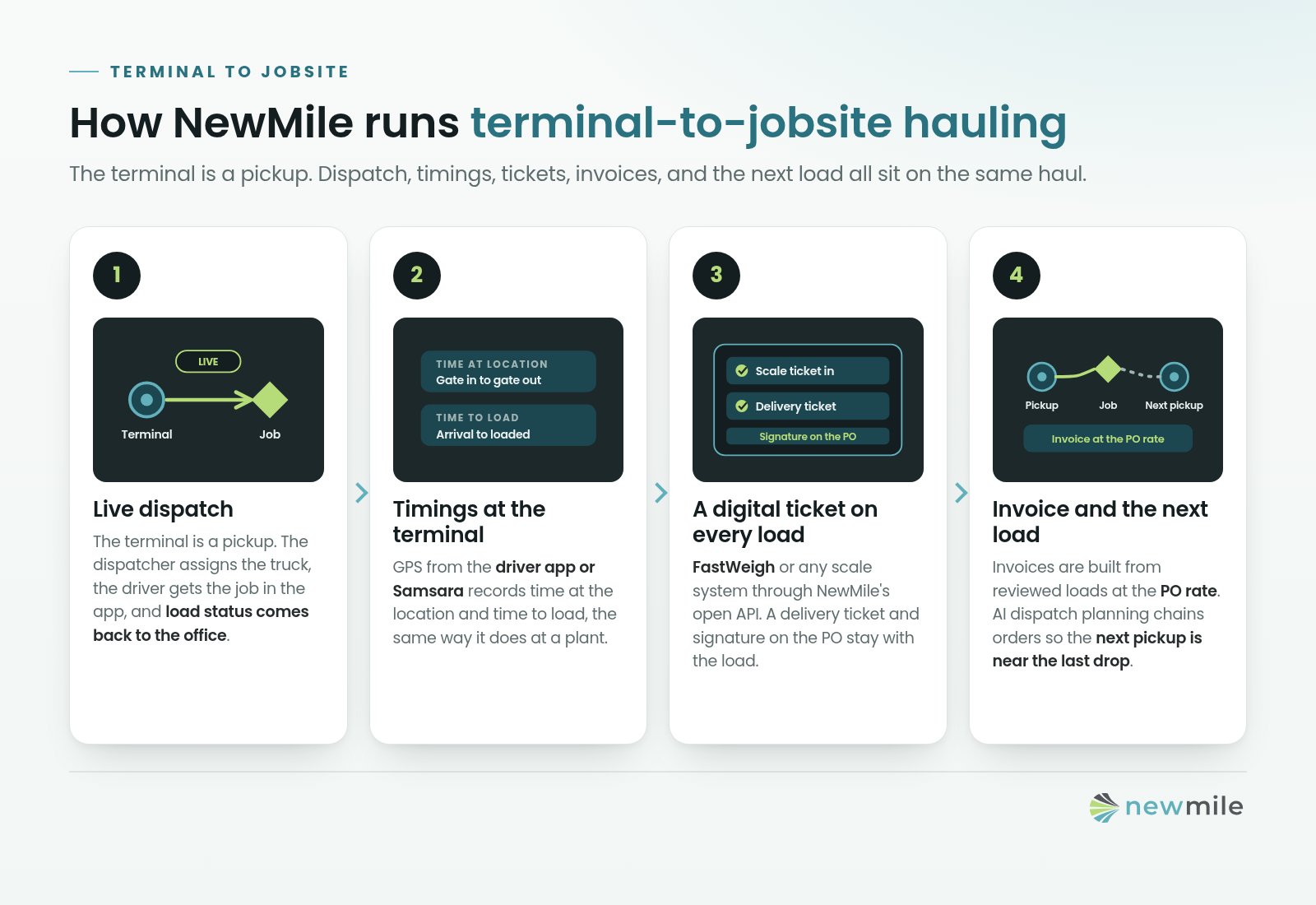
The stone can arrive by ship or by rail. The record of what left the terminal, and what landed on the job, should be the same record.
What to do with a bigger terminal
If you haul from a Florida port or rail terminal, or you are about to:
- Treat the terminal as a named pickup, with the same order, ticket, and invoice path you use at a plant.
- Connect the scale. If it runs FastWeigh, turn the integration on. If it doesn’t, put the ticket data through NewMile’s open API so the weight that left the terminal is the weight on the load.
- Require a delivery ticket and signature on the PO, so proof of delivery is attached before the truck leaves the job.
- Watch time at the terminal, by hour of the day, the same way you already watch a plant gate.
- Plan the day as one day, with every terminal order and every truck on the table at once, so the next pickup sits near the last drop.
How NewMile helps
NewMile is built for the whole delivery, from order to load to ticket to invoice. For terminal-to-jobsite work:
- Live dispatch and load status cover the haul from the terminal gate to the job.
- Pickup timings show time at the terminal and time to load.
- Digital tickets come from FastWeigh or any scale system, and a delivery ticket and signature can sit on the same load.
- Invoices are built from reviewed loads at the PO rate, with every line tied to its ticket.
- AI dispatch planning chains orders so the next pickup is near the last drop.
See NewMile for haulers, for suppliers, for contractors, and the full feature list.
Want to see a terminal-to-jobsite haul in NewMile — dispatch, tickets, invoices, and tomorrow’s plan? Request a demo. It’s a short walkthrough with no commitment.
Frequently asked questions
What did FDOT announce on November 6, 2026?
The Florida Department of Transportation posted a Notice of Intended Grant Awards for fiscal year 2028 funding under its Construction Aggregate Program. It intends to award $20 million across six seaport and rail terminal projects, including $3 million for the SeaPort Manatee Aggregate Terminal Expansion and $3.5 million for the Range Line Aggregate Rail Terminal. The same day, it posted a separate notice intending to award part of fiscal year 2027 funding, including $2 million more for Range Line and $2 million for the Hookers Point Aggregate Terminal at Port Tampa Bay.
Why is the last mile still a truck if the stone arrives by ship or rail?
Ship and rail move construction aggregate to a Florida terminal. Contractors need that stone at the job. The trip from the terminal to the jobsite is a dump-truck haul: a pickup, a ticket, a run, a drop, and an invoice.
How does NewMile run hauling from a port or rail terminal?
The same way it runs a plant haul. The terminal is a pickup. Dispatch assigns the load and tracks it live. GPS from the NewMile driver app or Samsara times each load at the terminal, including time at the location and time to load. A digital ticket sits with every load. Invoices are built from reviewed loads at the PO rate. AI dispatch planning chains orders so the next pickup is near the last drop.
Can NewMile take tickets from the terminal scale?
Yes. NewMile connects with FastWeigh, and its open API accepts ticket data from any scale software. The scale ticket attaches to the load, so the weight that left the terminal is the weight on the ticket and the invoice.
How are invoices built for terminal-to-jobsite loads?
From the reviewed loads, at the PO rate, with freight and material kept separate. Each invoice line traces back to its load and ticket. Contractors can view received invoices in NewMile and download them as PDFs or export a CSV.
How does AI dispatch planning help when trucks run from a terminal?
It plans the whole fleet's day at once instead of one order at a time. Orders are chained so a truck's next pickup is near its last drop, empty miles are priced into the plan, and the schedule is built on drive times and measured time on site. Your dispatcher reviews, edits, and approves it.
See the whole picture on a walkthrough.
A 15-minute demo on loads, tickets, and invoices — no commitment.